
deep-sleep pillow selection should start with the job requirements, measurement conditions, material trade-offs, accessory fit, and supplier proof. This guide summarizes the key checks before buying.
Table of Contents
deep-sleep pillow: Key Buying Factors
A deep-sleep pillow is not a medically defined pillow category or proof that a product will increase deep sleep. The phrase may describe a branded model, an ergonomic pillow, or a design marketed for greater nighttime comfort. For shoppers, the useful question is simpler: does the pillow keep the head and neck in a comfortable position for your body, mattress, and sleeping style?
Loft, contour, firmness, and adjustability usually deserve more attention than an impressive product name. Cooling covers and premium foams may improve comfort, but they cannot compensate for the wrong height. Start by measuring the pillow and checking its construction rather than relying on a promise of deeper sleep.
What Is a Deep-Sleep Pillow?
The term commonly refers to a pillow designed around one or more comfort features, such as slow-rebound memory foam, cervical contours, multiple neck heights, pressure distribution, or a breathable cover. It can also appear as a product name, so two pillows using the same phrase may have very different dimensions and intended uses.
No pillow can guarantee a particular sleep stage. Deep sleep is affected by health, stress, room conditions, sleep timing, medication, and other factors. A well-fitted pillow may create a more comfortable sleep environment, but it should not be promoted as a treatment for insomnia, migraines, or cervical disorders.
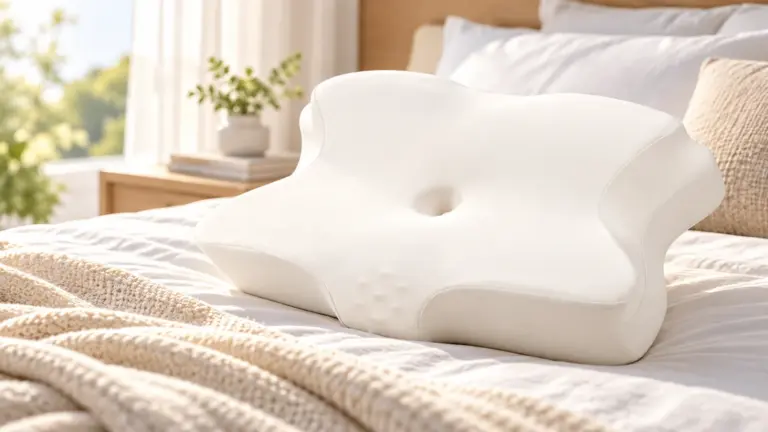
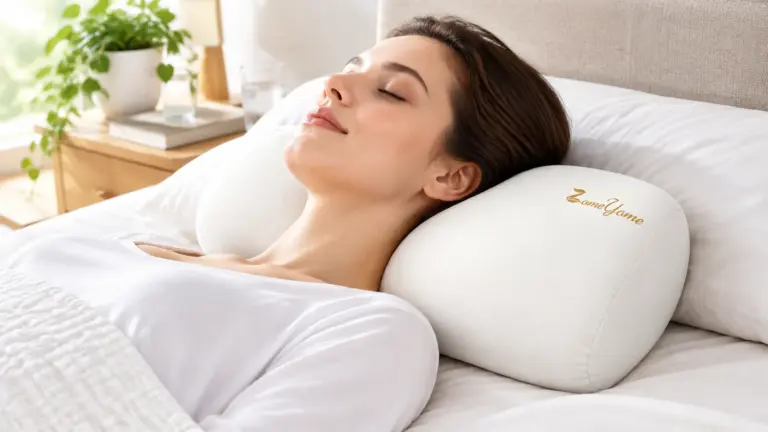
ZomeYome approaches this category with a contoured pillow made from BASF slow-rebound memory foam. The listed design includes two neck heights, a butterfly-shaped profile, and a removable knitted cover. These features provide several fit options, but shoppers should still confirm the actual measurements before deciding whether either side matches their preferred loft. Best practice: treat “deep-sleep” as a description to investigate, not a performance guarantee.
Quick Guide: Which Pillow Features Matter Most?
A useful comparison begins with measurable specifications. Product photos can show the contour, but they rarely reveal whether the pillow will hold the cervical spine in a neutral position once the sleeper’s head compresses the foam.
| Feature | Why It Matters | What to Verify |
|---|---|---|
| Loft | Controls the angle between the head, neck, and mattress | High and low edges in inches and centimeters |
| Firmness | Affects compression and perceived support | Soft, medium, or firm feel under load |
| Adjustability | Helps accommodate changing positions | Removable fill, inserts, or multiple usable heights |
| Contour | Creates space for the head, neck, shoulders, or arms | Shape, orientation, and intended sleeping position |
| Dimensions | Determines bed and pillowcase compatibility | Length, width, height, and suitable case size |
| Cooling design | May improve surface comfort in warm conditions | Cover fiber, knit structure, ventilation, and washability |
| Care | Affects hygiene and long-term usability | Separate instructions for the cover and foam core |
| Weight | Matters for travel and repositioning | Net product weight, not shipping weight |
| Trial and returns | Reduces uncertainty when fit cannot be tested | Eligibility, time limits, condition rules, and return costs |
| Warranty | Clarifies coverage for manufacturing defects | Duration, exclusions, and required documentation |
Exact dimensions, weight, trial terms, return conditions, and warranty coverage should appear in the current product listing. If any item is missing, ask for it before ordering. Best practice: compare pillows with a specification table instead of comparing marketing adjectives.
Why Loft and Shape Matter More Than Material Alone
Pillow loft is the unloaded height of the pillow, while effective loft is the height remaining after the head settles into it. This distinction matters with memory foam because body weight, temperature, and foam firmness can change how deeply the sleeper sinks.
Research has examined pillow heights in an approximate range of 7–11 cm, or 2.8–4.3 inches, but that range is not a universal prescription. A study on pillow height and head-neck biomechanics found that height can influence pressure and cervical alignment. More height is not automatically better; excessive loft may increase pressure and place the head at an uncomfortable angle.
Contour geometry also matters. A cervical pillow for sleeping often uses a raised neck roll with a lower center cradle. Butterfly-shaped designs add side areas that can create shoulder or arm space. The shape must match how the pillow is oriented, so users should follow the product diagram rather than rotating it at random.
Mattress firmness changes the calculation. Shoulders sink farther into a soft mattress, which can reduce the pillow height needed by a side sleeper. A firm mattress allows less shoulder immersion and may require more loft. Body build has a similar effect: broader shoulders often create a larger gap during side sleeping. Best practice: evaluate pillow height together with shoulder width and mattress firmness.
Choosing a Pillow by Sleep Position and Body Build
Side sleepers
A side sleeper pillow should fill the space between the ear and mattress without pushing the head upward. Shoulder width, mattress sink, and foam compression all affect the result. A higher contour may suit some side sleepers, but the correct choice cannot be confirmed without measured loft. For more position-specific guidance, review this guide to a memory foam pillow for side sleepers.
Back sleepers
Back sleepers generally need enough support beneath the neck without forcing the chin toward the chest. A central head cradle can reduce effective height beneath the skull while a neck roll supports the cervical curve. Check whether the contour feels stable without creating pressure at the base of the head.
Stomach sleepers
Stomach sleeping already rotates the neck, so excessive loft can add extension or side bending. A lower edge may be more suitable, although some stomach sleepers prefer a thin, flatter pillow rather than a pronounced cervical contour. The softest or lowest available side is not automatically appropriate if it still feels tall under load.
Combination sleepers
People who change positions need room to move and may benefit from an adjustable loft pillow or a dual-height pillow. ZomeYome’s listed design provides two neck heights rather than one fixed edge. Suitability still depends on the undisclosed measured heights and the sleeper’s build.
Studies of pillow-height adjustment suggest that individualized height can matter, while a randomized crossover trial comparing dynamic and fixed pillow-height systems reported benefits from responsive adjustment in its study setting. These results do not prove that one pillow works for every position. Best practice: choose the position you use most often, then confirm that the alternate height supports your secondary position.
Memory Foam, Latex, and Adjustable Designs
An ergonomic memory foam pillow responds gradually to body heat and pressure. ZomeYome’s listed BASF foam has a 3–5 second slow-rebound response, which is intended to create controlled contouring rather than an immediate spring-back feel. Memory foam can feel supportive and stable, although some sleepers may notice warmth, initial odor, or slower movement than with resilient materials.
Latex typically responds faster and feels more buoyant. It may suit sleepers who dislike the close contour of memory foam, but material alone does not establish ergonomic performance. A latex pillow with the wrong loft can fit worse than a properly sized foam pillow.
Adjustable-fill models allow users to add or remove material. This can improve loft flexibility, though loose fill may shift and requires periodic redistribution. Fixed molded contours hold a defined shape but offer fewer adjustment options. Dual-height designs occupy the middle ground by providing two usable edges without loose fill.
- Choose molded memory foam if you prefer slower contouring and a stable shape.
- Consider latex if fast response and buoyancy matter more than close molding.
- Choose adjustable fill if fine-tuning loft is your main priority.
- Consider dual-height contours if you want two defined neck-support options.
New foam products may need time to regain shape after compressed packaging, and odors can vary. Buyers should confirm the manufacturer’s expansion guidance, ventilate the pillow in a dry room, and avoid using heat unless the instructions allow it. Best practice: select material only after identifying the loft and contour you need.
Do Cooling Pillows Actually Improve Sleep?
A cooling pillow for hot sleepers can use breathable fabric, moisture management, ventilation channels, or heat-responsive materials. These features may make the surface feel more comfortable, especially in a warm bedroom. ZomeYome’s listed cover uses a high-elasticity knitted fabric with a breathable mesh structure and moisture-wicking design.
Cooling comfort should not be confused with proven changes in sleep architecture. A systematic review and meta-analysis of bedding-assisted body cooling did not establish reliable improvements across outcomes such as sleep onset, sleep efficiency, total sleep duration, or sleep-stage proportions. Results also depend on the thermal environment and the cooling method.
A breathable cover cannot make the foam core temperature-neutral in every room. Bedding, humidity, sleepwear, and airflow also influence heat retention. Washability may be more valuable than a dramatic cooling label because a clean cover can manage oils and perspiration over time. Readers comparing fabrics and airflow features can consult this cooling memory foam pillow guide. Best practice: assess cooling as a comfort feature, not evidence that a pillow increases deep sleep.
Certifications, Materials, and U.S. Safety Claims
Certification language needs careful reading. CertiPUR-US, when valid for a specific flexible polyurethane foam, concerns the qualifying foam rather than the entire finished pillow. It does not automatically certify the cover, zipper, thread, adhesives, ergonomic design, odor level, durability, or long-term comfort.
The available ZomeYome information describes the foam as certified but does not identify a certification program or provide documentation. It would therefore be inappropriate to call this product a CertiPUR-US foam pillow without current verification. Buyers should request the certification name, scope, certificate details, and model applicability before relying on the claim.
U.S. federal mattress flammability rules should not automatically be presented as pillow certifications. The U.S. Consumer Product Safety Commission guidance addresses mattresses, mattress pads, and mattress sets. A seller should identify the exact standard behind any pillow safety statement rather than borrowing mattress terminology.
Material transparency also means separating each component: foam core, cover fabric, zipper, mesh panels, and any adhesive or treatment. Best practice: verify which component was tested, which standard was used, and whether the specific product is covered.
Buyer Checklist: Specifications, Care, and Long-Term Fit
Before buying, confirm the measurements of both contour edges in inches and centimeters. Ask whether dimensions were taken before or after expansion, and verify overall length and width for pillowcase compatibility. Product weight is especially important if the pillow will be used for business travel, hotels, office breaks, or camping.
- Record your primary and secondary sleep positions.
- Measure the loft of a current pillow that feels close to correct.
- Account for shoulder width and mattress firmness.
- Compare high and low contour measurements.
- Confirm foam type, firmness description, and rebound behavior.
- Check whether only the cover is washable.
- Review expansion and ventilation instructions.
- Read the trial, return, and warranty terms before checkout.
The ZomeYome pillow has a removable cover listed as machine washable. That does not mean the foam core should enter a washing machine. Foam commonly requires different care, so follow the current product instructions and use a protective pillowcase if appropriate.
Shape retention should be evaluated realistically. Foam quality and construction influence resilience, but no pillow should be assumed to maintain identical comfort indefinitely. Check periodically for permanent impressions, cracking, uneven support, or changes that prevent the head and neck from resting comfortably.
A deep-sleep pillow is unsuitable when its lowest edge remains too tall, its contour restricts natural movement, or its material sensitivity conflicts with the sleeper’s needs. Persistent or severe neck pain, numbness, weakness, or headaches should be assessed by a qualified clinician rather than managed through pillow changes alone. Best practice: make the decision from verified measurements, care requirements, and fit—not from the product name.
FAQ
Frequently Asked Questions
Can a pillow increase deep sleep?
No pillow can guarantee deeper sleep. Cooling or ergonomic features may improve comfort, but evidence does not confirm reliable changes in sleep stages.
What pillow height is best?
The right height depends on sleep position, shoulder width, mattress firmness, and compression. Confirm loaded and unloaded loft.
Can one pillow fit every position?
Not always. Dual-height or adjustable designs offer flexibility, but each height must still match the sleeper.
Can a pillow be too high?
Yes. Excessive loft may increase pressure and change head-neck posture.
Can I wash memory foam?
Check the instructions. Removable covers may be machine washable, while foam cores usually require separate care.
Discuss Your Deep-Sleep Pillow Requirements
Compare contour, care, and fit details in the ZomeYome cervical neck pillow guide before choosing your next pillow.