
Table of Contents
pillow for neck pain relief: Key Buying Factors
The right pillow for neck pain relief may reduce morning stiffness by supporting a more neutral position during sleep. However, no single pillow shape, material, or firmness works for everyone. Your sleep position, shoulder width, body size, mattress firmness, and movement patterns all influence the fit.
A pillow is not a cure for chronic neck pain. Research suggests that some designs can improve comfort or waking symptoms, but average benefits are often modest and inconsistent. The most practical strategy is to prioritize fit, test the pillow carefully, and adjust the loft when possible.
Can the Right Pillow Help Relieve Neck Pain?
Your cervical spine has a natural curve. During sleep, a suitable pillow fills the space between your head, neck, shoulders, and mattress without pushing the head sharply upward or allowing it to drop.
If the pillow is too high, the neck may remain flexed for hours. If it is too low, the head can tilt backward or sideways. Either problem may contribute to muscle tension, pressure, and stiffness after waking. A supportive pillow aims to limit these extremes rather than force the neck into a rigid position.
A systematic review and meta-analysis of pillow designs found that outcomes vary across pillow types and studies. Small samples, different materials, short follow-up periods, and mixed participant groups make it difficult to identify one universal winner.
That is why labels such as cervical, orthopedic, or premium should not decide the purchase. Choose a pillow by how well it supports your normal sleeping posture. Best practice: treat symptom relief as a possible benefit, not a guaranteed medical result.
Quick Pillow Selection Chart by Sleep Position
Sleep position provides a useful starting point because it changes the distance between the head and mattress. The following chart offers general guidance rather than fixed prescriptions.
| Sleep position | Typical loft direction | Useful support profile | Potential drawback |
|---|---|---|---|
| Side | Medium to high | Supportive edge, stable fill, room for the shoulder | Excess loft may tilt the head upward |
| Back | Low to medium | Gentle neck contour with a shallow head cradle | A deep cradle may restrict movement |
| Stomach | Very low or minimal | Soft, compressible construction | Any thick pillow can increase neck rotation |
| Combination | Adjustable medium range | Responsive fill and less restrictive contours | Highly sculpted shapes may hinder position changes |
Side sleepers
Side sleepers generally need more loft because the pillow must bridge the distance created by the shoulder. Broad shoulders, a firm mattress, or a larger frame can increase the required height. A pillow that compresses too deeply may lose support before morning.
Look for stable edges, consistent neck support, and enough surface area for comfortable repositioning. Best practice: check whether your nose stays aligned with the center of your chest when viewed from the front.
Back sleepers
Back sleepers often benefit from moderate support beneath the neck and slightly less height beneath the head. A contoured memory foam pillow or cervical support pillow may provide this profile, but an aggressive contour can feel restrictive.
Your chin should not be pushed toward your chest. Best practice: use the lowest height that supports the natural neck curve without creating a backward head tilt.
Stomach and combination sleepers
Stomach sleeping holds the neck in prolonged rotation and may aggravate existing symptoms. If changing position is difficult, a thin, soft pillow can reduce the angle. Some sleepers may prefer little or no head elevation.
Combination sleepers need a design that adapts as they turn. Adjustable fill and gently contoured surfaces often allow easier movement than a deep central cradle. Best practice: choose mobility over an extreme ergonomic shape if you change positions frequently.
How Pillow Height and Shape Affect Neck Alignment
Pillow loft is the compressed height under your head, not simply the height displayed on a product page. Two pillows with the same listed dimensions can perform differently because their foam density, fill volume, firmness, and resilience vary.
Research has examined central pillow heights around 7 to 11 centimeters, but this range is context rather than a prescription. A study of different pillow heights and cervicothoracic alignment illustrates how height can change spinal positioning. Individual anatomy and mattress response still matter.
Shoulder width, body size, and mattress firmness
A side sleeper with broad shoulders may require greater loft than a smaller sleeper. A soft mattress allows the shoulder to sink farther, which can reduce the height needed. A firm mattress creates less sinkage and may require more pillow support.
Body proportions are more useful than height alone. Neck length, head size, shoulder shape, and preferred arm position can all affect comfort. Best practice: evaluate the pillow while lying on your own mattress, not while standing or pressing it by hand.
Contour shapes and central cradles
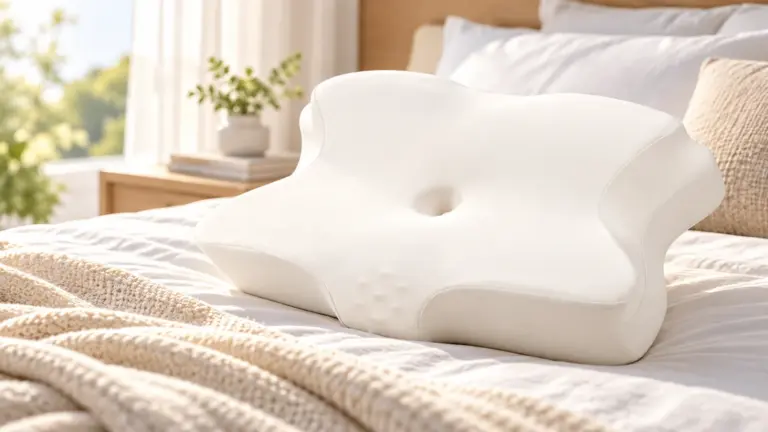
A contour memory foam pillow usually has raised neck rolls and a lower central area. This structure can help some back and side sleepers distribute pressure around the cervical curve. Butterfly-style designs may also provide space for the shoulders or arms.
The trade-off is reduced freedom of movement. Deep cradles, steep contours, or narrow sleep zones may not suit active sleepers. Best practice: confirm that the shape supports your preferred posture without locking your head into one position.
Memory Foam, Latex, Spring, or Adjustable Fill?
Material affects pressure response, heat retention, shape stability, noise, and adjustability. It should be evaluated together with loft and contour rather than treated as a shortcut to better neck support.
Memory foam
Solid memory foam responds slowly and can provide a stable contour. It may suit sleepers who want consistent support and limited fill movement. However, dense polyurethane foam may retain heat, and a fixed shape leaves little room for loft adjustment.
Shredded memory foam is more moldable and may allow users to remove fill. It can feel less stable than a solid foam core, and the pieces may shift during the night. Best practice: choose solid foam for structure or shredded foam for adjustability.
Latex
Latex usually feels more responsive than memory foam. It tends to rebound quickly, resist deep sinking, and allow easier position changes. Some research has reported favorable results for rubber or latex pillows, but this does not prove that latex is best for every sleeper.
Latex can feel too buoyant or firm for people who prefer a deep cradle. It may also be heavier than fiber-filled alternatives. Best practice: consider latex when responsiveness and shape retention matter more than slow contouring.
Spring and hybrid constructions
Spring pillows use small coils or spring-like components to create responsive support. A short-term trial has reported improvements in several outcomes, although the effects were small and cannot establish a universal advantage.
Construction quality can influence noise, weight, and pressure distribution. These products may also offer fewer adjustable options. Best practice: review the internal structure and return terms before choosing an unfamiliar spring design.
Adjustable fill
An adjustable loft pillow allows the user to add or remove filling. This can be valuable when the ideal height is uncertain or when mattress changes affect alignment. Common fills include shredded foam, fiber clusters, latex pieces, or mixed materials.
Adjustment requires patience. Removing too much fill can create an uneven surface, while overfilling may make the pillow hard and tall. Best practice: change a small amount at a time and test each setting for several nights.
Features Worth Paying For
Useful features solve practical sleep problems. Decorative terminology and higher prices do not automatically indicate better support.
- Adjustable loft: Useful for uncertain fit, combination sleeping, or households with different body proportions.
- Breathable cover: A removable cover can improve airflow and simplify routine washing.
- Ventilated construction: Perforated foam or open internal channels may help heat move away from the sleep surface.
- Shape retention: Important for side sleepers who need stable support through the night.
- Washable components: Check whether only the cover or the entire pillow can be washed.
- Clear return terms: A realistic home trial is more useful than judging a pillow for a few minutes.
- Warranty details: Review what counts as a defect and whether normal softening is excluded.
Cooling covers can improve the initial feel, but they cannot eliminate heat created by dense internal materials. Hot sleepers should assess the cover, foam structure, fill movement, and room conditions together.
Before purchasing, read the current care, trial, return, and warranty policies rather than assuming they are standard. Best practice: prioritize adjustability and return flexibility when you are unsure about the correct loft.
Certifications and US Safety Claims Explained
Certification language can be helpful when its scope is understood. For example, CertiPUR-US applies to eligible flexible polyurethane foam and addresses defined content, emissions, and durability criteria. It does not prove that a pillow is cooling, ergonomically effective, or capable of relieving pain.
Buyers should also avoid applying mattress regulations to pillows without evidence. The US Consumer Product Safety Commission explains that federal mattress requirements cover specified mattresses, mattress pads, and mattress sets. A reference to 16 CFR Part 1632 should not automatically be presented as a pillow standard.
Claims such as hypoallergenic, orthopedic, medical-grade, or eco-friendly also require context. Ask what material, test method, certification body, or product component supports the statement. Best practice: use certification to answer a defined safety or material question, not as proof of neck pain relief.
How to Test and Adjust a Pillow at Home
A structured home test is more reliable than choosing by softness alone. Allow for a short adaptation period, but do not ignore symptoms that clearly worsen.
- Start with your usual position. Test the pillow on the mattress you use every night.
- Check alignment. Ask someone to take a side or front photo while your body is relaxed.
- Record morning symptoms. Note stiffness, headaches, shoulder pressure, numbness, and sleep interruptions.
- Adjust gradually. Add or remove small amounts of fill instead of making a large change.
- Recheck movement. Make sure you can turn without fighting the contour or sliding off the support zone.
- Review after several nights. Compare trends rather than reacting to one unusual night.
If you wake with your chin pushed forward, try a lower setting. If your head drops toward the mattress while side sleeping, add loft or choose a more stable core. Persistent ear or shoulder pressure may indicate excessive firmness.
Individualized height adjustment has produced meaningful improvement for some study participants, but not for everyone. Best practice: change one variable at a time so you can identify what improves or worsens comfort.
When Neck Pain Needs Medical Care
A new pillow is not an appropriate response to every type of neck pain. Seek professional evaluation when pain follows an accident, fall, sports injury, or other trauma. Prompt care is also important when symptoms are severe, persistent, or progressively worsening.
Medical assessment may be needed for pain that radiates into the arm, weakness, numbness, tingling, loss of coordination, balance changes, fever, unexplained weight loss, or a severe headache. These symptoms can involve conditions that a pillow cannot diagnose or treat.
Even without red flags, recurring pain may require a clinician to review posture, work habits, joint function, muscle condition, and other contributing factors. Best practice: use a supportive pillow as one part of a broader comfort plan, not as a substitute for diagnosis.
The practical takeaway: The best pillow is the one that keeps your neck close to neutral, matches your sleeping position, and remains comfortable through normal movement. Compare fit before marketing labels, and choose an adjustable design when your ideal loft is uncertain. For more selection guidance, read this guide to the best pillow for neck and shoulder pain relief.
Authoritative reference: The 10 Best Pillows For Neck Pain To Ease Aches And Stiffness.
FAQ
Frequently Asked Questions
What type of pillow is best for neck pain?
No type is best for everyone. Match loft, firmness, contour, and material to your position and body proportions.
How high should the pillow be?
Use enough loft to keep the neck neutral. Side sleepers usually need more height than back or stomach sleepers.
Is memory foam or latex better?
Memory foam offers slower contouring; latex feels more responsive. Choose according to pressure preference, heat sensitivity, and movement.
Can stomach sleeping worsen neck pain?
It can, because the neck remains rotated. A very thin pillow may reduce the angle if you cannot change positions.
Does CertiPUR-US prove pain relief?
No. It addresses defined polyurethane foam content and emissions criteria, not cooling, ergonomics, or clinical effectiveness.
Discuss Your Pillow For Neck Pain Relief Requirements
Ready to compare contour, loft, and sleep-position fit? Explore the ZomeYome contour pillow guide and identify the support profile that matches the way you sleep.